How to Buy Property in Dubai: Step-by-Step Guide 2026
How to buy property in Dubai in 2026: every step for foreign buyers, all fees (4% DLD transfer), expat mortgage rules and the Golden Visa tie-in explained.
How to Buy Property in Dubai: Step-by-Step Guide 2026
Wondering how to buy property in Dubai as a foreigner or expat resident? The good news: the process is one of the most streamlined in the world — foreign buyers can own freehold property outright in designated areas, no residence visa is required, and a cash purchase can complete in around 30 days. This step-by-step guide walks you through both the ready (secondary) and off-plan routes, every fee you will pay, and how your purchase can unlock UAE residency in 2026.
Buying Property in Dubai — At a Glance
- Who can buy: Any nationality — freehold “without restriction” in designated areas (Regulation No. 3 of 2006, as amended); no UAE visa and no age limit required
- Main government fee: 4% DLD transfer fee (legally 2% seller + 2% buyer; in practice the buyer pays all 4%)
- Typical deposit: 10% cheque on signing Form F (market practice, negotiable)
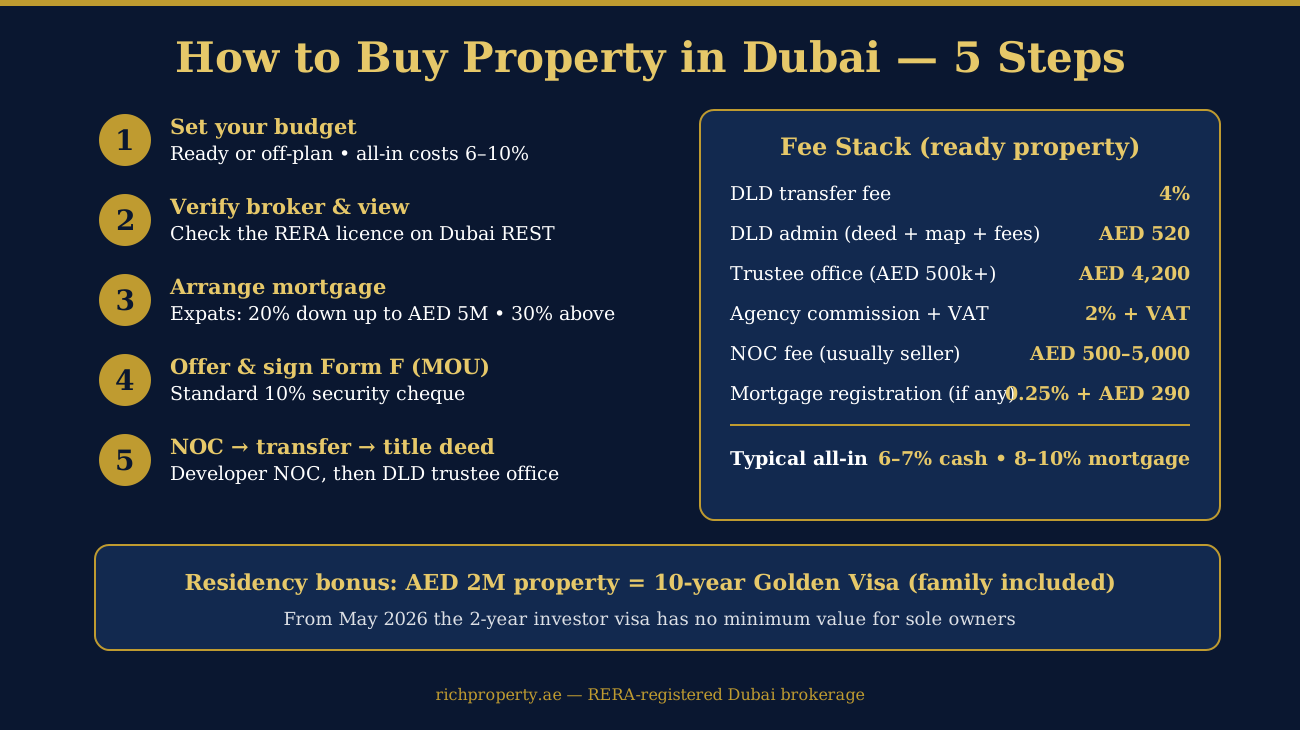
- All-in costs: roughly 6–7% of price for cash buyers, 8–10% with a mortgage
- Expat mortgage down payment: 20% up to AED 5M (max 80% LTV); 30% above AED 5M
- Off-plan protection: all payments go into a RERA-supervised escrow account (Law No. 8 of 2007)
- Timeline: ~30 days cash; ~6–10 weeks with a mortgage
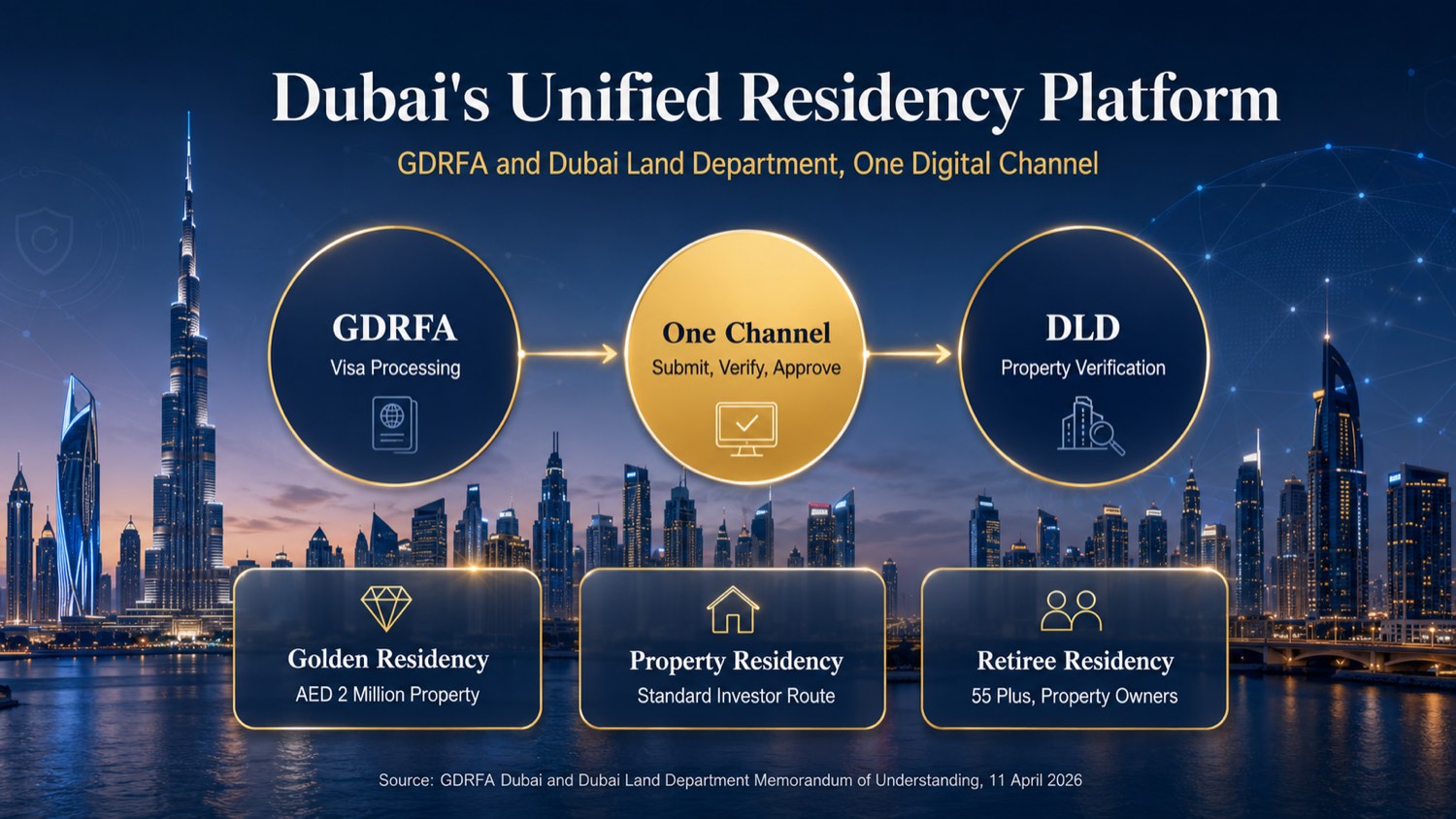
- Residency: Golden Visa from AED 2M; 2-year investor visa now has no minimum value for sole owners (May 2026)
Can Foreigners Buy Property in Dubai?
Yes. Under UAE government guidance, foreign non-residents and expatriate residents may acquire freehold ownership “without restriction”, usufruct rights, or leasehold rights of up to 99 years in areas of Dubai designated for non-national ownership under Regulation No. 3 of 2006 (issued under Dubai’s property law). Title deeds are issued by the Dubai Land Department (DLD), and there is no age limit to own property.
The designated freehold areas (per Regulation 3 of 2006 as amended and subsequent designations) include Palm Jumeirah, Dubai Marina, Downtown Dubai, Business Bay, JLT, JVC, Dubai Hills Estate, Arabian Ranches and Dubai Creek Harbour, among others. For a full map of where foreigners can buy, see our Dubai freehold areas guide.
Documents are minimal: DLD requires the Emirates ID of buyer and seller — or a valid passport for non-resident foreigners — plus a developer e-NOC in freehold areas. A UAE residence visa is not required to buy.
Step 1: Set Your Budget — Ready or Off-Plan?
Your first decision shapes everything that follows:
- Ready (secondary) property: immediate handover, rental income from day one, mortgage up to 80% LTV. You’ll typically pay a 2% + VAT agency commission on resale deals.
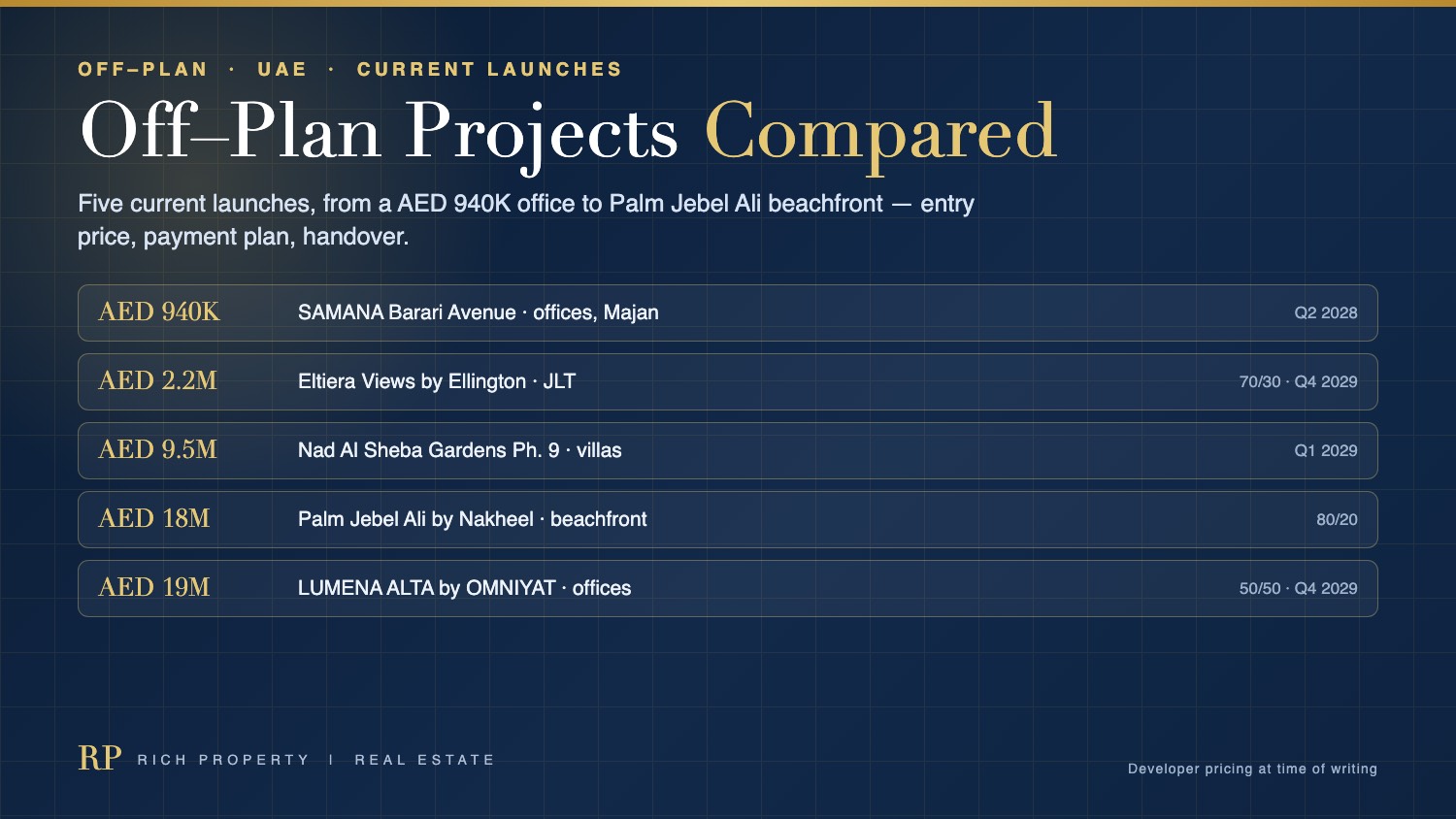
- Off-plan property: lower entry prices and staged payment plans — booking down payments of 10–20% (Emaar’s 2025–26 launches almost all take 10%; Nakheel asks 20%), with common structures of 80/20, 60/40 and 50/50 (construction/handover). Post-handover plans also exist, commonly 40–60% during construction and the balance over 2–5 years after handover, usually interest-free. Buying direct from the developer normally carries no buyer commission.
Browse current off-plan projects in Dubai or ready properties for sale to compare both routes. If you’re a UAE resident who has never owned freehold here, ask about the government’s First-Time Home Buyer programme (launched July 2025 by DLD and DET): as of June 2026 it has 22 participating developers, around 45,000 registrants and over 3,200 residents who became first-time owners, with sales surpassing AED 5 billion — offering priority launch access and preferential pricing.
Step 2: Verify Your Broker and View Properties
Only deal with RERA-registered brokers. You can check any broker’s registration and licence number on the Dubai Land Department website, the Dubai REST app, or DubaiNow before signing anything. Dubai’s brokerage forms are standardised: Form A is the seller–broker listing agreement (a seller may hold a maximum of 3 at a time, approved through DLD’s Trakheesi system, which assigns every advert a permit number), Form B is the buyer–broker agreement you sign with your agent, Form F is the sale contract itself, and Form U lets either party terminate an agency agreement unilaterally.

Step 3: Mortgage Basics for Expats and Non-Residents
If you’re financing, get pre-approval before you offer. The UAE Central Bank caps loan-to-value (LTV) ratios (Circular 31/2013, as amended by the 2020 resolution):
- Expat first home: max 80% LTV (20% down) up to AED 5M; max 70% above AED 5M
- UAE nationals: 85% up to AED 5M / 75% above
- Second/investment property: max 60% LTV for expats (65% nationals)
- Off-plan: max 50% LTV for everyone — which is why most off-plan buyers use developer payment plans and mortgage at or after handover
Other Central Bank limits: maximum tenor 25 years, loan must end by age 65 (salaried) or 70 (self-employed), debt repayments capped at 50% of gross monthly income, and total financing capped at 7 years’ income for expats (8 for nationals). There is no official minimum salary — banks set their own floors, roughly AED 10,000–25,000/month depending on lender, with around AED 15,000 a common comfort level. Non-residents (no UAE visa) can still get a mortgage, but are typically limited to around 50% LTV with fewer lenders and stricter documentation.
Step 4: Make an Offer and Sign Form F (the MOU)
Form F is DLD’s unified sale contract for secondary-market deals, mandatory since 1 May 2014 — and since 1 August 2024 it must be digitally generated and e-signed via Dubai REST or DLD-authorised systems (trustee offices no longer accept paper). It becomes valid once signed by both parties and witnessed by the agent. On signing, the buyer typically provides a 10% security deposit cheque — common market practice, negotiable, not set by statute — which is held uncashed by the RERA-registered broker (never handed to the seller) until transfer completes. The completion window commonly written in is around 30 days for cash deals, though this too is negotiable.
Buying off-plan instead? You sign the developer’s Sale and Purchase Agreement, and the law protects you two ways. First, under Law No. 8 of 2007 (Article 6), every dirham you pay must go into the project’s dedicated escrow account with a DLD/RERA-approved bank, released to the developer only as construction progresses. Second, your contract must be registered in DLD’s provisional register (Oqood) within 90 days of signing — your registered proof of ownership until the title deed is issued at handover. The Oqood fee is the same 4% DLD charge (buyer pays in practice, + AED 10 knowledge + AED 10 innovation fees), and converting Oqood to a title deed at handover does not trigger a second 4%. Developers also charge their own admin fees (commonly AED 1,000–5,000) and periodically run “DLD waiver” promotions covering 50–100% of the 4% fee.
Step 5: Developer NOC, Then Transfer and Title Deed
For a ready property, the seller obtains a no-objection e-certificate (e-NOC) from the developer confirming no outstanding service charges — a required document for sale registration in freehold areas. NOC fees commonly fall between AED 500 and 5,000 (usually paid by the seller, though parties may agree otherwise) and processing takes several working days — guides commonly cite 2–7 business days. Confirm the exact fee and whether VAT is included with the developer in writing.
The final transfer happens at a DLD-approved Real Estate Registration Trustee office: documents are verified, fees paid, ownership transferred and the new title deed issued — DLD lists the service completion time as just 25 minutes. For simple cases (mortgage-free, restriction-free units in freehold areas), DLD’s “Buy or Sell Property via Dubai Now” channel lets you do the whole thing digitally 24/7, with a lower service-partner fee of AED 1,000 + VAT (or AED 500 + VAT below AED 500K) and a digital title deed verifiable via Dubai REST.
Cost of Buying Property in Dubai — Full Fee Breakdown
- DLD transfer fee: 4% of the sale value (legal split 2% seller / 2% buyer per Executive Council Resolution No. 30 of 2013; buyer almost always pays all 4% by agreement)
- DLD admin fees: AED 250 title deed certificate + AED 250 map (villas/apartments) + AED 10 knowledge + AED 10 innovation = AED 520 for a typical apartment (Property Finder’s “AED 580” shorthand rounds this up; the official DLD itemisation is AED 520)
- Registration trustee fee: AED 4,000 + 5% VAT (= AED 4,200) for properties of AED 500,000+; AED 2,000 + VAT (= AED 2,100) below that
- Agency commission: typically 2% + 5% VAT, buyer pays on resale; usually none on off-plan direct from developer
- If mortgaged: DLD mortgage registration 0.25% of the loan + ~AED 290 admin (AED 3,290 total on a AED 1.2M loan), bank valuation AED 2,500–3,500 + VAT, and an arrangement fee commonly up to ~1% of the loan (caps vary by bank)
- NOC fee: AED 500–5,000 (usually seller-paid)
All-in, budget roughly 6–7% of the purchase price on top for cash buyers, and 8–10% for mortgage buyers.
Residency Bonus: Golden Visa and the 2026 Investor Visa Change
Property worth at least AED 2 million (based on the full DLD-recorded value — multiple properties may be aggregated) qualifies you for the renewable 10-year Golden Visa; mortgaged property is acceptable with a lender NOC, and in Dubai you obtain DLD certification first, then apply via GDRFA/ICP. Industry reports state that as of February 2026 the older 50%-paid condition for mortgaged properties was dropped — though this is not yet confirmed on official government pages. Full details in our Dubai Golden Visa through property guide.
Even bigger news for smaller budgets: confirmed on 1 May 2026 (published via DLD’s Cube Centre on 29 April), Dubai removed the AED 750,000 minimum for the two-year property investor residence visa. Sole owners of qualifying property of any value can now apply; for jointly owned property, each co-owner’s share must be at least AED 400,000, and financed properties are eligible.
Ready to buy your first Dubai property?
Rich Property is a RERA-registered Dubai brokerage guiding foreign buyers and expats through every step — from shortlisting freehold apartments and off-plan launches to Form F, transfer and Golden Visa eligibility. Message us on +971 56 887 7078 or email invest@richproperty.ae and we’ll map your budget to the right community and payment plan.
Browse Dubai PropertiesFAQ — Buying Property in Dubai for Foreigners
Can foreigners buy property in Dubai without residency?
Yes. Non-residents can buy freehold property in designated areas with just a valid passport — no UAE visa is needed, and there is no age limit. Title deeds are issued in your name by the Dubai Land Department.
How much money do you need to buy a property in Dubai?
Beyond the price, budget roughly 6–7% extra in fees for cash purchases (4% DLD transfer, AED 520 admin, AED 4,200 trustee, 2% + VAT commission) or 8–10% with a mortgage. Expat mortgage buyers also need at least a 20% down payment on homes up to AED 5M.
What are the steps to buying a property in Dubai?
Set your budget and choose ready or off-plan, verify a RERA broker, get mortgage pre-approval if financing, sign Form F with a ~10% deposit (or the developer’s SPA with escrow payments for off-plan), then complete the developer NOC and transfer at a trustee office, where the new title deed is issued in about 25 minutes.
Do you get a residence visa if you buy property in Dubai?
Buying alone doesn’t grant residency, but it unlocks visa routes: AED 2M+ in property qualifies you for the 10-year Golden Visa, and since May 2026 the two-year investor visa has no minimum value for sole owners (AED 400,000 per share if jointly owned).
Can I get a mortgage in Dubai as a non-resident?
Yes, though options are narrower: non-residents are typically limited to around 50% LTV with fewer lenders and stricter documentation. UAE-resident expats qualify for up to 80% LTV on a first home up to AED 5M, with tenors up to 25 years.
Source: Dubai Land Department (dubailand.gov.ae), UAE Government portal (u.ae), UAE Central Bank mortgage regulations (Circular 31/2013 as amended), Law No. 8 of 2007 and Executive Council Resolution No. 30 of 2013, with market-practice figures from established UAE property guides. Fees, regulations and visa rules can change — always confirm current requirements with DLD, your bank and the developer before transacting.