Off-Plan vs Ready Property Dubai 2026: Full Buyer Guide
Off-plan vs ready property in Dubai 2026: AED 139.75B off-plan vs AED 146.69B ready sales, payment plans, escrow rules, risks and which one fits you.
Off-Plan vs Ready Property Dubai 2026: Full Buyer Guide
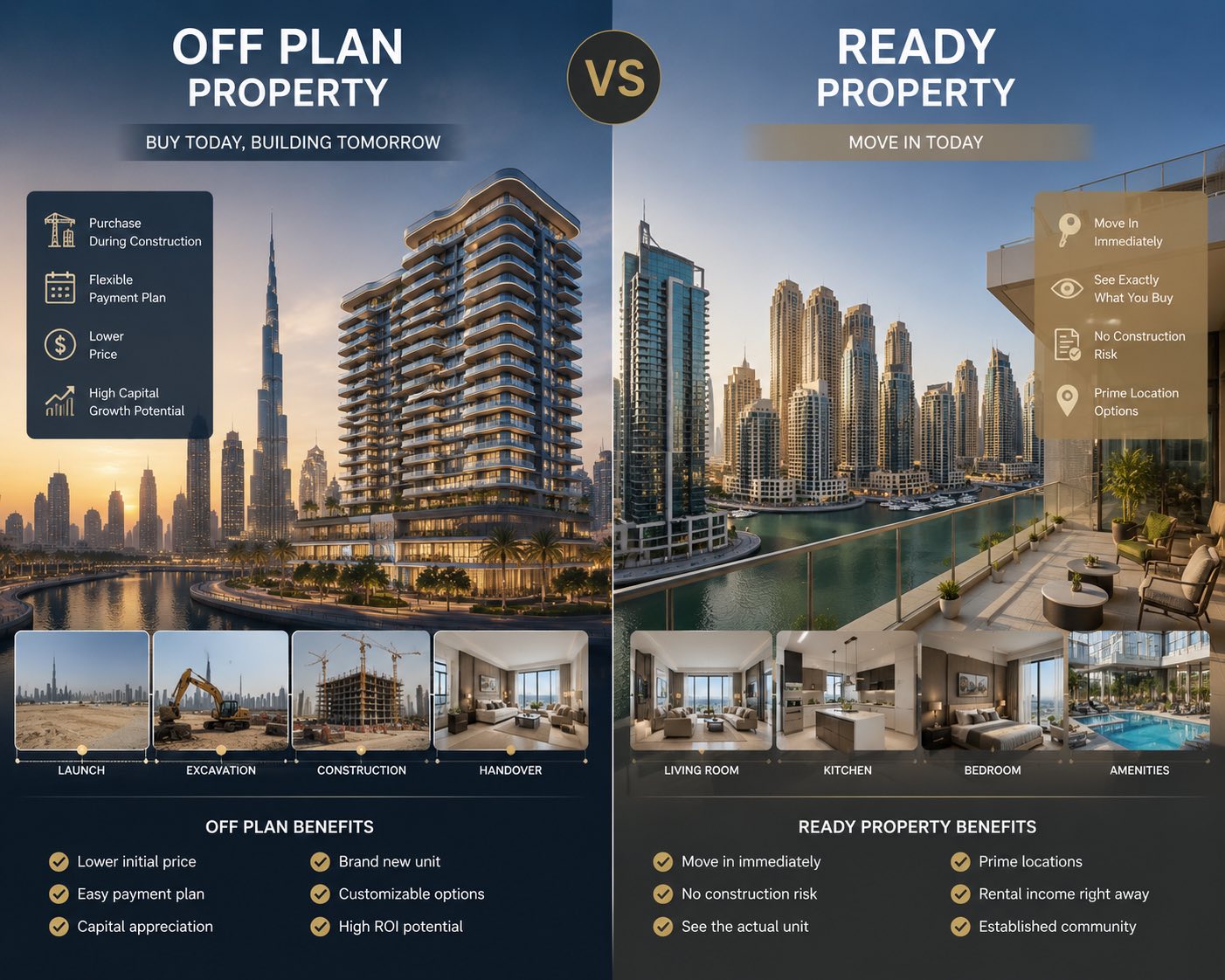
Off-plan vs ready property in Dubai 2026 is the first real decision every buyer faces — and in a market that closed H1 2026 with AED 291.7 billion in property sales across 87,800 deals, both routes are running hot. Off-plan dominated volume with 58,840 transactions worth AED 139.75 billion, while completed homes edged ahead on value at AED 146.69 billion across 27,160 sales. This guide explains how each purchase actually works, what you pay and when, the legal protections behind each, the honest risks and returns, and which type of buyer should choose which — so you decide with numbers, not marketing.
Off-Plan vs Ready in Dubai — At a Glance
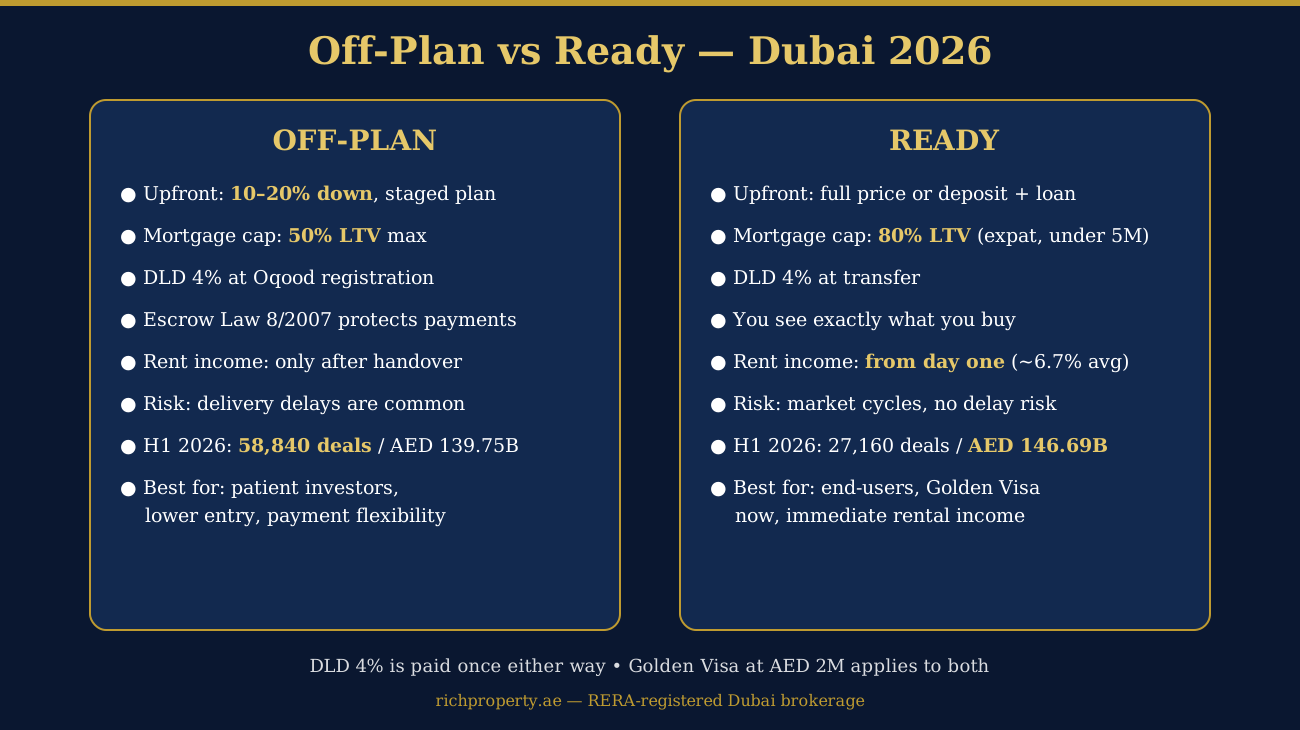
- H1 2026 sales: off-plan AED 139.75B (58,840 deals) vs ready AED 146.69B (27,160 deals) — roughly two-thirds of sales are off-plan
- Upfront cash: off-plan starts from a 10–20% down payment on a staged plan; ready needs the full price (or deposit plus mortgage) at transfer
- Mortgage cap: 50% LTV maximum on off-plan for everyone; up to 80% for an expat first home under AED 5M when buying ready
- DLD fee: 4% is paid once — at Oqood registration for off-plan; no second 4% at handover
- Protection: Escrow Law 8/2007 plus Oqood registration under Law 13/2008 — unregistered off-plan sales are legally void
- Income: only ready property earns rent from day one — Dubai gross yields average about 6.7%
- Risk: delivery delays are the base case — roughly half of announced handovers historically slip
How Off-Plan and Ready Purchases Work in Dubai
Buying off-plan means buying directly from a developer before (or during) construction. You reserve with a booking deposit, sign a Sale and Purchase Agreement, then pay instalments linked to construction progress. Every off-plan sale must be registered on the Dubai Land Department’s Interim Property Register — the Oqood system — under Law No. 13 of 2008. An unregistered off-plan sale is legally void, and your Oqood certificate gives you recognised interim ownership until the title deed is issued at handover. Usefully, the very fact a project can issue Oqood registrations means DLD and RERA have already vetted the developer’s land ownership and approvals before sales were permitted. You can browse current launches on our Dubai off-plan projects hub.
Buying ready means buying a completed home — developer stock or the secondary market. The transfer happens at DLD, the title deed goes into your name, and you can move in or list it for rent immediately. The step-by-step mechanics are covered in our guide to how to buy property in Dubai.
Off-Plan vs Ready Property Dubai 2026: What the Numbers Say
Dubai’s market entered 2026 off a record base: DLD reported AED 761 billion in real estate transactions across 226,000 deals in 2024, up 20% in value and 36% in volume year-on-year. In H1 2026, off-plan took roughly two-thirds of all sales (about 68% of unit sales), while ready homes carried more value per deal.
One myth to retire: off-plan is not automatically “cheaper than ready.” On 2026 transaction data, off-plan actually trades at roughly a 20–30% per-square-foot premium to ready stock, depending on the measure. The genuine launch advantage is narrower but real: early phases are priced below later phases of the same project, and construction-linked payment plans let you control an appreciating asset with far less cash upfront. Ready property’s edge is certainty — you inspect the actual unit, the actual view and the actual building before paying.
Money: Payment Plans, Mortgages and Fees Compared
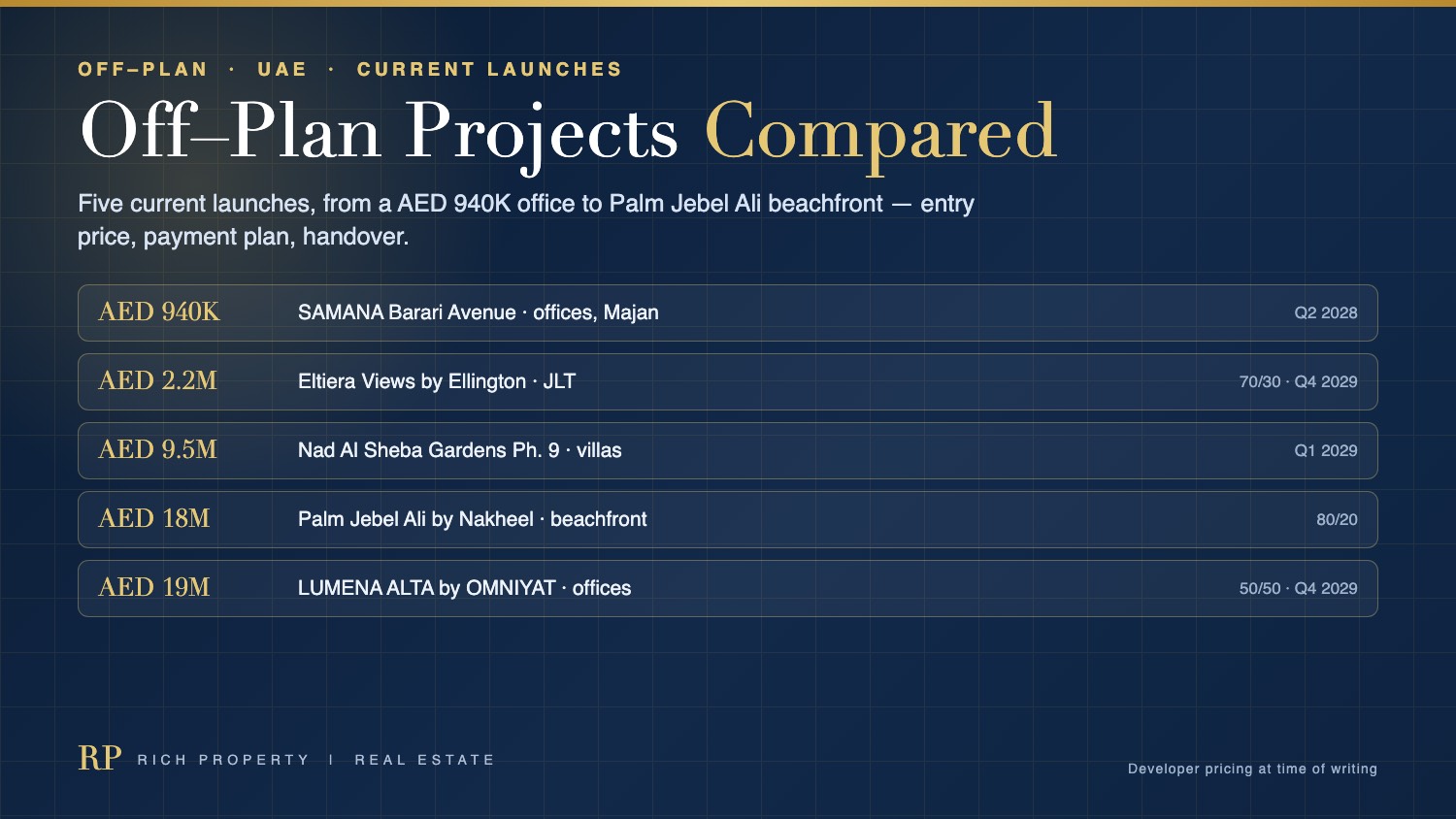
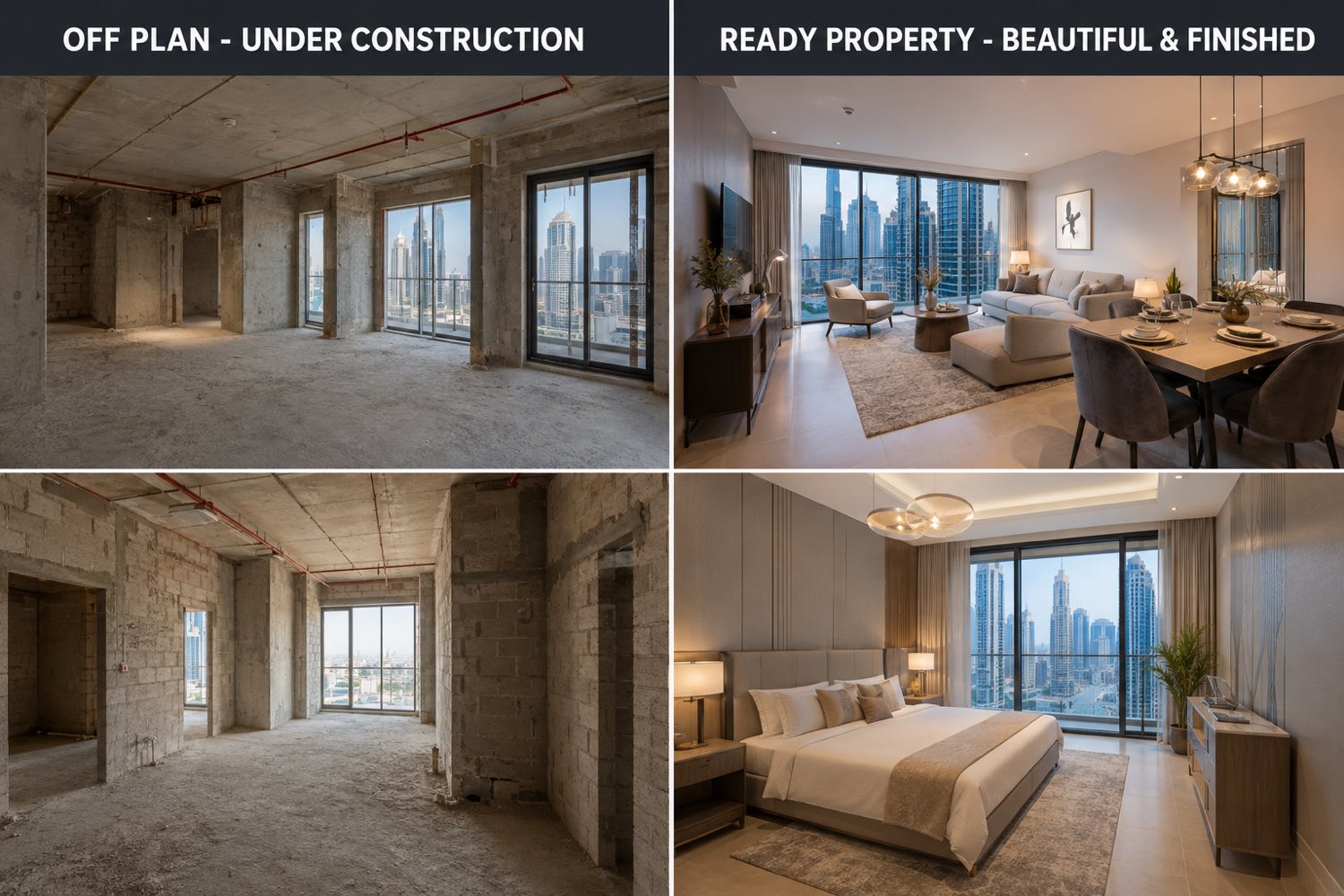
Off-plan is bought on construction-linked plans — 80/20, 60/40 and 50/50 structures dominate, per market practice. Booking typically starts with an EOI deposit of AED 20,000–100,000 (or 5–10%) credited to a down payment of 10–20%. Post-handover plans also exist, typically spreading the balance over 2–5 years after keys, with a few developers stretching to 7–8.
Mortgages flip the equation. Under UAE Central Bank rules, off-plan and under-construction property is capped at 50% loan-to-value for every buyer, regardless of price. Ready property is far more financeable: an expatriate first home up to AED 5M can borrow up to 80% (70% above AED 5M; 60% for a second or investment property), while UAE nationals get 85% / 75% / 65% on the corresponding tiers.
The 4% DLD transfer fee is charged once on the full purchase price in both cases — for off-plan it’s collected at Oqood registration (usually at booking or SPA signing), and no second 4% is due when the Oqood converts to a title deed at handover. One more cash-flow difference: off-plan owners pay service charges only from handover, while ready owners pay from day one — but only the ready owner is collecting rent to offset them.
Buyer Protections: Escrow, Oqood and When Things Go Wrong
Dubai’s off-plan regime is one of the most regulated anywhere. Under Escrow Law No. 8 of 2007, every project must have a dedicated escrow account opened in the project’s own name (Art. 9), managed by a DLD-accredited financial institution (Art. 10), and all buyer payments must be deposited into it (Art. 7). Funds are released to the developer in stages tied to construction progress under DLD/RERA supervision, and the escrow agent must retain 5% of the escrow value for a full year after the completion certificate (Art. 14) — a built-in snagging guarantee. If a project stalls, Art. 15 requires the escrow agent, after consulting DLD, to ensure the project is completed or depositors are refunded.
If RERA formally cancels a project, the developer must refund all purchaser payments through the escrow procedures; legal guides describe a RERA-appointed auditor instructing distribution of available escrow funds within about 14 days, with around 60 days for the developer to cover any shortfall, and unresolved cases going to a dedicated Special Tribunal.
Buyers have obligations too. If you default on instalments, Law 19/2017 lets the developer — after a 30-day DLD notice — retain up to 40% of the contract price when the project is over 60% complete, up to 25% below 60%, and up to 30% of amounts paid if construction never started for reasons beyond the developer’s control, refunding the excess.
Risks and Returns: Delays, Supply and Rental Yields
Delays are the base case, not the exception. Morgans Realty estimates only about 48% of announced Dubai handovers land on time — so plan your finances assuming your off-plan home arrives later than promised. On supply, a Khaleej Times analysis expects roughly 55,000 units to hand over in 2026 and about 75,000 in 2027 (other forecasters run higher), flagging JVC/JVT, Dubai South, MBR City, Business Bay and Dubailand Residence Complex as concentration zones — while noting 66% of the pipeline is studios and one-beds and villas remain undersupplied.
On returns: ready property pays you immediately. Dubai gross rental yields average about 6.7% (apartments around 7.1%, villas around 5%) — roughly double London’s 3–4% and well above New York’s 4–5%. Pair that with the new Smart Rental Index rules and a ready unit in a freehold area is a genuine income asset from week one. Off-plan produces zero income until handover — its case rests on entering early phases below later-phase pricing and paying in instalments while the project builds.
Can You Sell Off-Plan Before Handover?
Yes — off-plan resale (assignment) is standard practice and fully legal before handover, but it needs the developer’s No Objection Certificate, and most developers only permit it once roughly 30–40% of the price has been paid. The deal transfers your SPA/Oqood position to the new buyer, who inherits the remaining payment plan. It’s a real exit route, but not an instant one — factor the NOC step and the paid-percentage threshold into any short-horizon strategy.
Who Should Buy Which — Profiles and Verdict
Choose ready if: you need a home now; you want rental income from day one; you’re an expat first-time buyer who wants the 80% mortgage; or you value inspecting exactly what you’re buying. Start with our live Dubai property listings.
Choose off-plan if: you have a 2–4 year horizon, limited upfront cash but reliable instalment capacity, and you want the newest product in a growth corridor at early-phase pricing — ideally from an established developer, always escrow- and Oqood-protected. Compare current launches on our off-plan projects page.
Verdict: in 2026 there is no universal winner — the market itself is split almost 50/50 by value. Ready wins on certainty, financing and cash flow; off-plan wins on entry cost, payment flexibility and new-build upside. The right answer is the one that matches your cash position and your timeline — not the loudest launch campaign.
Off-plan launch or ready home — want the honest numbers on both?
Rich Property is a RERA-registered Dubai brokerage covering both markets: vetted off-plan projects with escrow-protected payment plans, and ready homes that rent from day one. Tell us your budget and timeline on +971 56 887 7078 or invest@richproperty.ae and we’ll shortlist both routes for you — with the trade-offs spelled out.
Browse Dubai PropertiesFAQ — Off-Plan vs Ready Property in Dubai
Is it better to buy off-plan or ready property in Dubai?
It depends on your goal. Ready property suits end users and income investors: rent from day one, yields averaging ~6.7%, and mortgages up to 80% LTV for expat first homes under AED 5M. Off-plan suits patient buyers who want early-phase pricing and staged 10–20%-down payment plans and can wait years for handover.
What are the risks of buying off-plan property in Dubai?
The main risks are delivery delays (roughly half of announced handovers historically slip), zero rental income until completion, and localised oversupply in high-pipeline areas. Escrow Law 8/2007 and Oqood registration protect your money from developer misuse, but they don’t protect you from a late or slow-appreciating project.
Can I sell my off-plan property before handover in Dubai?
Yes. Assignment before handover is legal and common, but it requires the developer’s NOC, and most developers only allow it after about 30–40% of the price is paid. The buyer takes over your Oqood position and the remaining instalments.
Is off-plan property cheaper than ready property in Dubai?
Market-wide, no — 2026 data shows off-plan trading at roughly a 20–30% per-square-foot premium to ready stock. The real saving is phase timing: early launch phases are priced below later phases of the same project, and payment plans sharply reduce the cash you need upfront.
What happens if an off-plan project in Dubai is delayed or cancelled?
If RERA cancels a project, the law requires all purchaser payments to be refunded through the escrow account, with a court-supervised tribunal handling disputes. For ordinary delays, your money remains ring-fenced in escrow and released only against verified construction progress — but budget for late delivery as the base case.
Sources: Dubai Land Department; Dubai Legislation (Law No. 8 of 2007, Law No. 13 of 2008, Law No. 19 of 2017); UAE Central Bank Circular 31/2013 as amended; Khaleej Times; Morgans Realty and 2026 market analyses. Figures correct as of publication; this article is general information, not financial or legal advice.