Dubai Shared Housing Law 2026 Owners Guide (Permits, Fines)
Can Dubai owners rent bed spaces legally in 2026? Full landlord guide to Law No. 4 permits, occupancy rules, AED 1,000,000 fines, 26 Aug 2027 grace deadline.

Dubai Shared Housing Law 2026 Owners Guide (Permits, Fines)
Dubai Law No. 4 of 2026 rewrote the rulebook for property owners who rent to multiple tenants, and if you own an apartment or villa in the city, this landlord guide walks you through exactly what shared housing permits, occupancy limits, partition rules and AED 1,000,000 fines mean for your yield. His Highness Sheikh Mohammed bin Rashid Al Maktoum issued the law on 11 March 2026, it takes effect on 26 August 2026, and every owner already renting rooms, beds or partitioned spaces has a one-year grace window to legalise the operation.
Dubai Shared Housing Law - At a Glance for Owners
- Law: Dubai Law No. (4) of 2026, issued 11 March 2026
- Effective: 26 August 2026 (180 days after gazette publication)
- Regulator: Dubai Municipality (permits, unified digital platform), coordinating with Dubai Land Department for the electronic contract registry and rent indicator
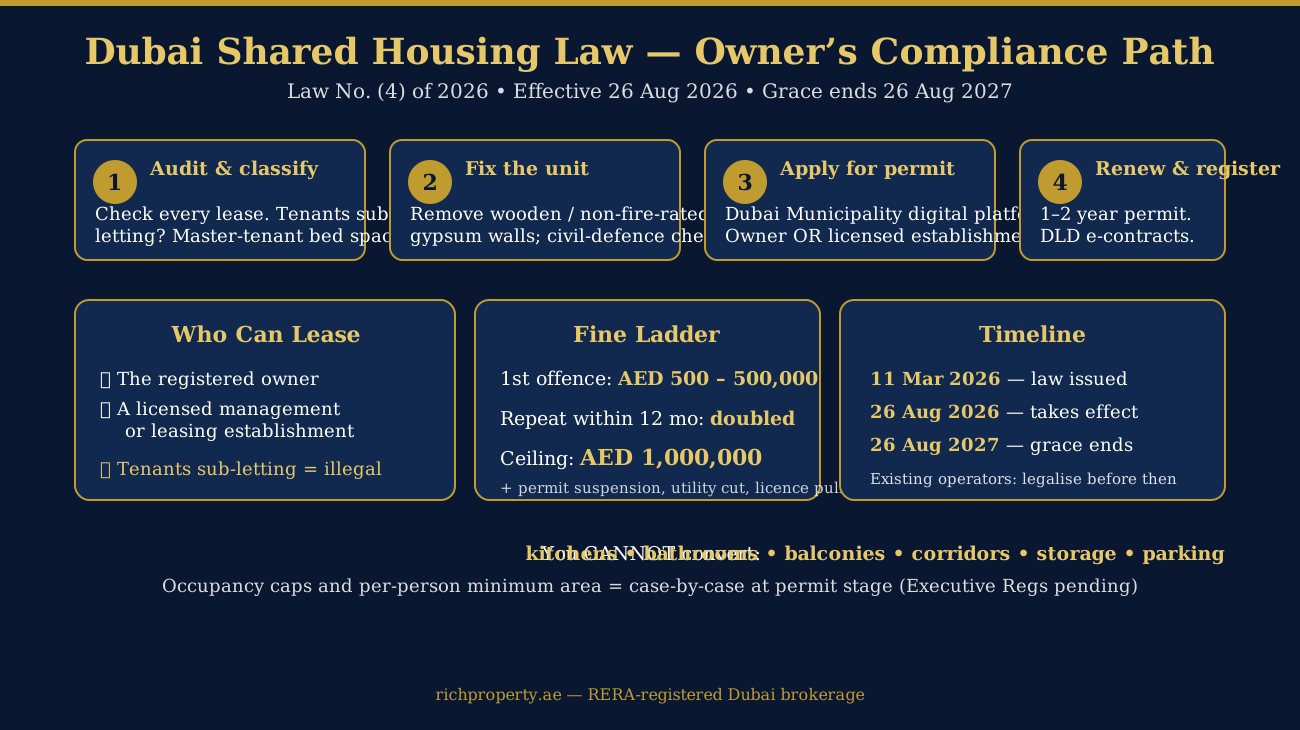
- Who may lease shared housing: the registered owner, or a licensed management/leasing establishment - tenants may not sublet
- Permit validity: 1 year renewable; up to 2 years on owner request; renew at least 30 days before expiry
- Fines: AED 500 - AED 500,000 per violation, doubled to a ceiling of AED 1,000,000 for repeat breaches within 12 months
- Other penalties: permit suspension or cancellation, revocation of the operator's trade licence, utility disconnection
- Grace period: 1 year from effective date - roughly 26 August 2026 to 26 August 2027 - to regularise existing operations
Can I rent bed spaces in my Dubai apartment in 2026?
Yes - but only if you hold a valid shared-housing permit issued by Dubai Municipality, or you appoint a licensed management establishment to run the unit for you. From 26 August 2026 onwards, renting bed spaces, partitioned rooms or shared bedrooms in a residential apartment or villa without that permit is a violation, and every violation carries a fine ranging from AED 500 to AED 500,000. Repeat the same breach within 12 months and the fine doubles up to a hard ceiling of AED 1,000,000, and your operator's trade licence and the property's utilities can also be pulled. The law is not designed to kill bed-space renting; it is designed to formalise it so buildings stay safe, neighbours stop complaining and the DLD registry knows who is really living in your unit.
Who Dubai Law No. 4 of 2026 lets lease a shared-housing unit
The law is unusually blunt about who may act as landlord in a shared-housing arrangement. Only two categories qualify:
- The registered property owner named on the title deed.
- An establishment licensed to manage or lease units on behalf of owners, or to lease from owners specifically for the purpose of subleasing to shared occupants.
Tenants - even a tenant on a valid Ejari - cannot legally sublet part or all of your apartment. That closes the popular loophole where an individual master-tenant would rent a 2-bedroom flat and re-let each room to strangers. If that is happening in your building, the person collecting rent from the bed spaces is on the wrong side of Law No. 4, and so, potentially, is the owner who allowed it. Landlord guide takeaway: audit every lease you have signed, and either bring the operation in-house under your own permit or transfer it to a licensed operator before 26 August 2027.
How to get a shared housing permit from Dubai Municipality
Dubai Municipality is the single competent authority for shared housing permits. It runs the unified digital platform where applications, renewals and inspections are handled, coordinates with Dubai Land Department on the electronic contract registry and rent indicator, and works with the regulators of special development zones and free zones so a single set of rules travels with your building. The core steps an owner should expect:
- Confirm the unit is legally permitted for residential use and that the community, master developer or free-zone regulator has no separate objection.
- Prepare the technical file for the unit - civil-defence-compliant fire safety, no wooden or non-fire-rated gypsum partitions, kitchens and bathrooms still functioning as kitchens and bathrooms.
- Apply for the permit on Dubai Municipality's platform, nominating either yourself as the owner or a licensed management establishment as the operator.
- Register each lease contract on the electronic registry once the permit is issued.
- Renew the permit at least 30 days before expiry - the permit runs 1 year at a time, and can be issued for up to 2 years if you request it upfront.
Permit and service-fee amounts will be set by a separate Executive Council decision that has not yet been officially gazetted, so budget for the fee once Dubai Municipality publishes the schedule rather than relying on WhatsApp-forwarded numbers.
Occupancy limits, partitions and what you cannot convert
Dubai Municipality assesses maximum occupancy and per-person space unit by unit at the permit stage; the detailed technical thresholds sit inside the executive regulations still to be issued by the Director General. That means a savvy owner does not guess a headcount - you prepare a compliant layout, present it in the permit application, and take the number Dubai Municipality signs off on.
What the law does say clearly is what you cannot do:
- No wooden partitions and no non-fire-rated gypsum walls to slice bedrooms into more bedrooms.
- No converting kitchens, bathrooms, balconies, corridors, storage areas or parking spaces into sleeping areas.
- No leasing of collective labour accommodation under this regime - staff accommodation continues to sit under its own labour-housing rules.
Landlord guide practical note: the partitioned rooms you routinely see in older Bur Dubai, Deira, Al Nahda, Discovery Gardens and International City apartments are exactly the layouts Dubai Municipality is targeting. If those are your units, factor a de-partition and reinstatement cost into your compliance budget before you apply.
Fines, permit suspension and utility disconnection: the enforcement ladder
The enforcement ladder is deliberately steep so owners do not treat compliance as optional:
- Financial: AED 500 to AED 500,000 per violation, doubled to a hard ceiling of AED 1,000,000 for repeat violations within 12 months.
- Administrative: the authority can suspend the shared-housing permit, cancel it outright, revoke the operator's commercial licence, and instruct utility providers to disconnect electricity and water at the offending unit.
Put in owner terms: one bad inspection can move you from a AED 500 slap to a six-figure penalty, and a second one within a year can wipe out the annual rental yield on a AED 2 million apartment. A utility disconnection also breaks every existing lease inside the unit and exposes you to tenant claims - the cost of non-compliance is not just the fine, it is the vacancy that follows it.
Grace period: what owners must fix before 26 August 2027
The law gives existing owners and operators a grace period of one year from the effective date to regularise - approximately 26 August 2026 to 26 August 2027. The Director General of Dubai Municipality may grant a one-time extension, but there is no guarantee an individual owner will receive one. Use the year like this:
- Month 1-2: inventory every rented unit, identify shared-housing arrangements, request a copy of every current tenancy contract.
- Month 3-4: get civil-defence and MEP contractor quotes to remove non-compliant partitions and reinstate kitchens or bathrooms where required.
- Month 5-8: decide who will be the permit holder - you as owner, or a licensed shared-housing operator - and sign a written management agreement.
- Month 9-11: file the permit application on Dubai Municipality's platform, register contracts on the DLD registry, refresh Ejari where lease terms change.
- Month 12: hold the permit, run the unit, and keep evidence for the first renewal (filed at least 30 days before expiry).
See our tenant-side guide for how your current occupants are affected - it is worth forwarding to every bed-space tenant so nobody is surprised when Dubai Municipality inspectors arrive.
Free zones, freehold communities and villas: does the law reach every Dubai owner?
Yes. The law applies inside special development zones and free zones as well as the wider Dubai jurisdiction. Rather than a fully separate parallel regime, free-zone and SDZ regulators coordinate with Dubai Municipality through the unified digital platform. So a landlord in DIFC, DMCC, JAFZA, TECOM or Dubai Silicon Oasis is inside the same framework as an owner in Dubai Marina or JBR, even if the first practical touchpoint is the zone regulator. Freehold community owners in Dubai's freehold areas - Downtown, Business Bay, Palm Jumeirah, Emirates Hills, Dubai Hills, Arabian Ranches, Al Furjan - are inside the law too, and so are villa owners renting rooms in Mirdif, Al Barsha South and JVC. If people who are not on the title deed and not related to the owner sleep in the unit, it is shared housing.
Owner ROI view: is compliant shared housing still worth it?
For many older-stock apartments and villas in mid-market communities, yes. A compliant, permitted shared-housing operation typically clears higher gross yield than a single-family Ejari lease, and Dubai's tenant demand is genuine - professionals, teachers, nurses and cabin crew all rent bed spaces because a whole apartment is out of reach. What Law No. 4 changes is the risk profile: informal operations that skated on a wooden partition and a WhatsApp group now carry six-figure downside. The cleanest owner response is to (a) formalise the layout, (b) hold the permit yourself or hand it to a licensed operator, and (c) price the unit against the DLD rent indicator so you stay defensible if a tenant files a complaint. Investors sizing a new purchase should also read our off-plan vs ready and Smart Rental Index guides before choosing between a shared-housing play and a straight family let.
Planning to buy, sell or restructure a Dubai rental for the new shared-housing regime?
Rich Property is a RERA-registered Dubai brokerage helping owners stay compliant while maximising yield. We can review your current tenancy stack, model the ROI of a permitted shared-housing setup versus a single-family lease, and connect you with licensed operators who will hold the permit for you. Talk to us before you file with Dubai Municipality.
Browse Dubai PropertiesFAQ - Dubai Shared Housing Law 2026 for Owners
Do I need a permit to rent my Dubai apartment to multiple tenants?
If the tenants are unrelated occupants sharing the unit - classic shared housing or bed-space renting - yes. The permit is issued for 1 year, renewable for equal periods, and can run up to 2 years at the owner's request; renewals must be filed at least 30 days before expiry.
How much is the fine for illegal shared housing in Dubai?
Between AED 500 and AED 500,000 per violation, doubled to a ceiling of AED 1,000,000 for repeat breaches within 12 months. The authority can also suspend or cancel the permit, revoke the operator's commercial licence, and disconnect utilities.
Can a landlord partition a room in a Dubai apartment for rent?
Not with wooden partitions or non-fire-rated gypsum walls. The law also forbids turning kitchens, bathrooms, balconies, corridors, storage areas and parking spaces into sleeping areas. Any structural or MEP change must be civil-defence compliant and reflected in the permit application.
How long is the grace period for owners under the new Dubai shared housing law?
One year from the effective date - roughly 26 August 2026 to 26 August 2027 - to regularise existing operations. The Director General of Dubai Municipality may grant a one-time extension, but do not count on it.
Does Dubai Law No 4 of 2026 apply to villas as well as apartments?
Yes. It applies to residential shared housing across Dubai, inside special development zones and free zones, in villas as well as apartments. It expressly does not cover collective labour accommodation, which stays under separate rules. See our eviction rules guide and selling your Dubai property for adjacent owner-side reading.
Source: Dubai Legislation Portal, Law No. (4) of 2026 https://dlp.dubai.gov.ae and Dubai Media Office announcement 11 March 2026 https://mediaoffice.ae/en/news/2026/march/11-03/mohammed-bin-rashid-issues-law-regulating-the-management. Not legal advice.