Cost of Living in Dubai 2026: Real Monthly Numbers
What living in Dubai really costs in 2026: rent by unit type, DEWA bills, the 5% housing fee, Salik tolls, schools and health cover, with three worked monthly budgets.
Cost of Living in Dubai 2026: Real Monthly Numbers
“How much do I need to live in Dubai?” is the question every new arrival asks, and almost every answer online is either a brochure or a horror story. The truth is that Dubai is not expensive or cheap — it is unusually elastic. Two families can live in the same city on budgets that differ by a factor of four, and the single biggest variable is not lifestyle. It is which postcode you sign a tenancy contract in.
Below is a realistic breakdown for 2026: what each line actually costs, the charges newcomers forget, and three worked monthly budgets with the assumptions written out so you can adjust them to your own situation.
The short answer
- Single professional, sharing or studio: roughly AED 7,000 – 11,000 per month all in
- Couple, 1–bedroom in a mid–market area: roughly AED 12,000 – 18,000 per month
- Family of four, 2–bedroom plus one school place: roughly AED 22,000 – 35,000 per month
- Rent is 40–55% of most budgets — it is the only decision that really moves the total
- No income tax on salary in the UAE, but there is 5% VAT on most goods and services
- The charge people forget: a housing fee of 5% of your annual rent, billed monthly through DEWA
1. Rent — The Decision That Sets Everything Else
Dubai rents are quoted annually, not monthly, and are traditionally paid in one to four cheques. Fewer cheques usually means a lower headline rent.
Dubai–wide typical ranges for 2026:
- Studio: approximately AED 35,000 – 85,000 per year
- 1 bedroom: averaging around AED 6,700 per month, so roughly AED 80,000 per year
- 2 bedroom: averaging around AED 10,000 per month, so roughly AED 120,000 per year
Where the postcode premium bites
In prime waterfront and Downtown districts the same unit types run far higher — a 2–bedroom in Downtown Dubai or Dubai Marina commonly sits in the AED 140,000 – 220,000 range, while established communities further from the coast can be half that for comparable space. Rental growth has moderated to roughly 10–13% a year from the sharper post–pandemic spikes, but demand is still firm.
Before you sign, check what the property is legally worth: the RERA rental index in the Dubai REST app gives the official benchmark for the building, and it also governs how much your landlord may raise the rent at renewal. We cover that in detail in how much your rent can legally increase.
Upfront costs on a rental
- Security deposit: typically 5% of annual rent for an unfurnished unit, 10% furnished
- Agency commission: commonly 5% of annual rent
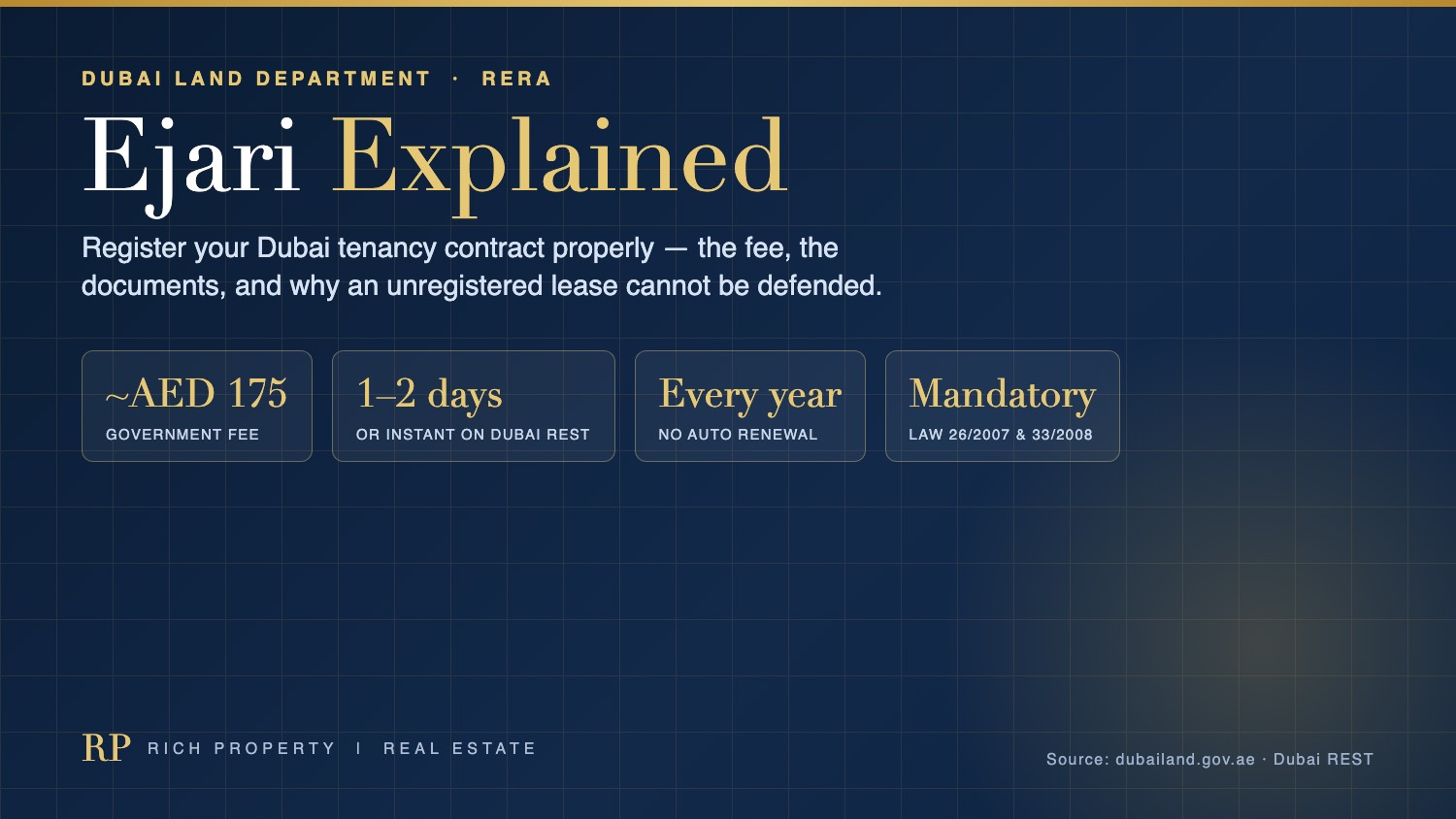
- Ejari registration: about AED 175 in government fees — see our Ejari guide
- DEWA deposit: refundable, roughly AED 2,000 for an apartment and AED 4,000 for a villa
Budget for 15–20% of the annual rent in cash before you get the keys.
2. Utilities and the Housing Fee
DEWA bills electricity and water on a progressive slab, so heavy users pay more per unit:
- Electricity: 23 fils per kWh up to 2,000 kWh, then 28, 32 and 38 fils as consumption rises
- Water: 3 fils per gallon up to 6,000 gallons, then 3.5 and 4 fils
- Plus a meter charge of around AED 20, a municipality sewerage charge of 0.5 fils per gallon, a fuel surcharge and 5% VAT
In practice: expect roughly AED 300 – 600 a month for a studio or one bedroom, AED 600 – 1,200 for a two bedroom, and considerably more for a villa with a garden or pool. Summer air conditioning is what moves this number — July and August bills can double the spring figure.
Also budget AED 300 – 500 a month for home internet, and note that some apartments add district cooling billed separately from DEWA — ask before signing, because it can add several hundred dirhams a month.
3. Getting Around
If you drive
- Salik tolls: since 1 June 2026 crossings are priced by time of day — approximately AED 6.30 at peak (06:00–10:00 and 16:00–20:00) and AED 4.20 off–peak, both including VAT, with no charge between 01:00 and 06:00. There are 10 gates across the emirate
- A commute crossing two gates twice a day at peak runs to roughly AED 500 a month
- Parking, fuel, insurance and servicing on top — residential parking permits and building parking vary widely
If you use public transport
The Metro, tram and buses run on a nol card with zone–based fares, and it is dramatically cheaper than driving — a monthly pass costs a fraction of tolls plus fuel plus parking. Living within walking distance of a Metro station is one of the most effective ways to cut a Dubai budget, which is exactly why those buildings command a rental premium.
4. Groceries, Eating Out and Everyday Life
- Groceries: roughly AED 800 – 1,500 per month for one person, AED 2,500 – 4,000 for a family of four. Shopping at Carrefour, Union Coop or Lulu rather than premium supermarkets changes this materially
- Casual meal out: AED 40 – 80 per head; mid–range dinner for two AED 250 – 500
- Coffee: AED 18 – 28
- Gym: AED 200 – 500 per month
- Mobile plan: AED 100 – 250 per month
- Domestic help: part–time cleaning from roughly AED 35 – 50 per hour
5. Health Insurance and Schooling — The Two Big Ones
Health insurance
Health cover is mandatory in Dubai. Employers must provide it for employees; you are responsible for dependants. Basic individual plans start at a few hundred dirhams a year, while comprehensive family cover with wider hospital networks runs into the thousands. Check what your employer’s policy actually covers before you assume the family is included.
School fees
If you are moving with children, this is frequently the largest line in the budget after rent — and it varies enormously by curriculum and school rating. Fees run from around AED 15,000 a year at the affordable end to well past AED 100,000 at the most established British and IB schools, per child. The KHDA publishes fees and inspection ratings for every private school in Dubai, and it is the only sensible place to start.
Add uniforms, transport and registration fees, which are not included in the headline number.
6. Three Worked Monthly Budgets
Assumptions are written out so you can adjust them. All figures are monthly in AED.
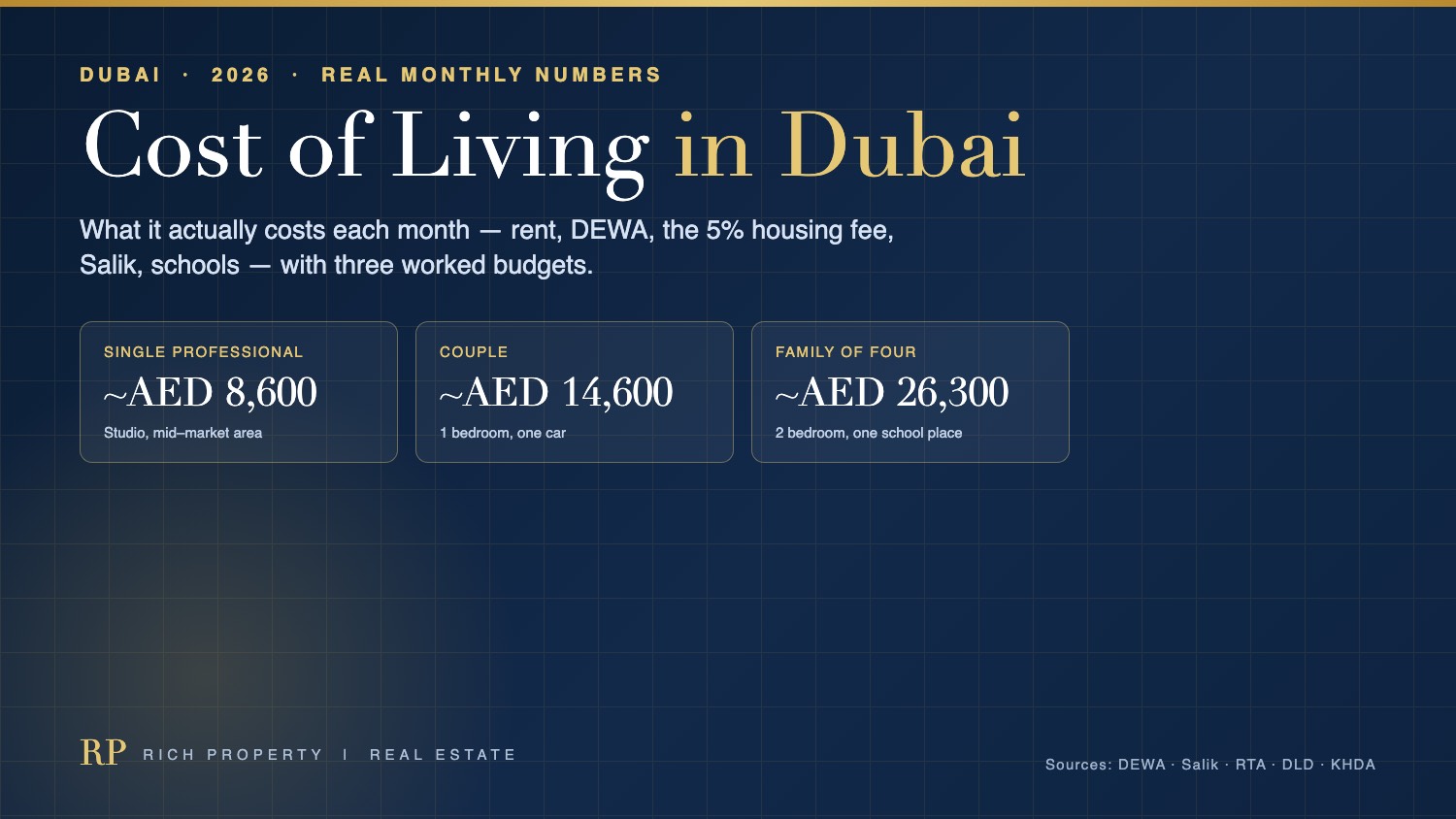
Single professional — studio in a mid-market area
- Rent (AED 60,000/yr): 5,000 · Housing fee: 250 · DEWA: 400 · Internet: 350
- Groceries: 1,000 · Transport (nol): 350 · Mobile: 150 · Gym: 300 · Eating out and leisure: 800
- Total: around AED 8,600
Couple — 1 bedroom, one car
- Rent (AED 90,000/yr): 7,500 · Housing fee: 375 · DEWA: 650 · Internet: 400
- Groceries: 2,000 · Car (fuel, Salik, parking, insurance): 1,500 · Mobiles: 300 · Health cover for a dependant: 400 · Leisure: 1,500
- Total: around AED 14,600
Family of four — 2 bedroom, one school place
- Rent (AED 130,000/yr): 10,800 · Housing fee: 542 · DEWA: 1,000 · Internet: 400
- School fees (one child, mid–tier, AED 55,000/yr): 4,600 · Groceries: 3,200
- Car: 1,800 · Mobiles: 350 · Health cover for dependants: 900 · Help and childcare: 1,200 · Leisure: 1,500
- Total: around AED 26,300
Two children in school instead of one, or the same family in Downtown rather than a mid–market community, pushes that past AED 40,000 without any change in lifestyle. That is the elasticity in action.
7. Where the Real Savings Are
- Choose the area, not the finish. Moving one ring inland from the water routinely saves 30–40% of rent for the same square footage
- Pay rent in fewer cheques if you have the cash — landlords discount for it
- Live near a Metro station and run one car instead of two
- Check the RERA index before renewing — a proposed increase above the permitted band is challengeable
- Ask whether cooling is district or DEWA before signing. This single question has cost people thousands
And the structural point: at these rent levels, buying often beats renting within a few years. A 2–bedroom at AED 130,000 a year is AED 650,000 of rent over five years with nothing to show for it. If you expect to stay, it is worth modelling the mortgage against the lease — see our step–by–step guide to buying in Dubai and the freehold areas where foreigners can buy.
Renting now, thinking about buying?
Rich Property is a RERA–registered Dubai brokerage. Tell us your monthly housing budget and we will show you honestly what it buys versus what it rents — including service charges, which most comparisons quietly leave out. We are in The Opus Tower, Business Bay.
Browse Dubai PropertiesFAQ - Cost of Living in Dubai
How much salary do you need to live comfortably in Dubai?
A single professional is generally comfortable from around AED 12,000 – 15,000 a month, a couple from around AED 20,000, and a family of four with one child in school from roughly AED 30,000 – 35,000. Comfortable means saving something each month, not merely covering bills.
Is there income tax in Dubai?
There is no personal income tax on salaries in the UAE. There is 5% VAT on most goods and services, and corporate tax applies to businesses rather than employees.
What is the housing fee on my DEWA bill?
A Dubai Municipality charge equal to 5% of your annual rent, divided across twelve monthly DEWA bills. On AED 100,000 annual rent it is roughly AED 417 a month.
How much are DEWA bills each month?
Roughly AED 300 – 600 for a studio or one bedroom and AED 600 – 1,200 for a two bedroom, rising sharply in the summer air–conditioning months and much higher for villas.
Is it cheaper to rent or buy in Dubai?
Over a short stay renting is more flexible. Over five years or more, buying frequently costs less in total once you account for rent paid with no equity — provided you include service charges and the roughly 6–10% all–in transaction costs in the comparison.
How much should I budget upfront to move into a rental?
Plan on 15–20% of the annual rent in cash to cover the security deposit, agency commission, Ejari and the DEWA deposit before you receive the keys.
Sources
Sources: DEWA published residential tariff slabs for electricity and water, meter and municipality charges — dewa.gov.ae. Salik toll pricing and the time–based rates effective 1 June 2026 — salik.ae. Public transport fares and nol — rta.ae. Official rental benchmarks and the RERA rental index — Dubai Land Department and the Dubai REST app, dubailand.gov.ae. School fees and inspection ratings — khda.gov.ae. Rent ranges are market averages compiled from 2026 Dubai rental market data and vary significantly by building, floor, view and contract terms. All figures are indicative for planning only and change over time — verify current tariffs, tolls, fees and rents with the official sources above before making financial decisions. This article is general information, not financial advice.