Dubai Salary Guide 2026: What People Earn, What It Buys
Dubai salaries in 2026: the 1.6% average rise, indicative pay bands by level, the skills earning premiums, and what a tax-free package really buys after rent.
Dubai Salary Guide 2026: What People Earn, What It Buys
“What salary do I need in Dubai?” and “what will I earn there?” are two different questions, and most guides answer neither honestly. The honest version: Dubai salaries are tax–free, they vary enormously by sector and seniority, and in 2026 pay rises have become selective — strong for scarce skills, close to flat for everything else.
Here is what the 2026 data actually says, what typical bands look like, and the question that matters more than the headline number: what your salary leaves you after Dubai’s real monthly costs.
Dubai salaries in 2026 at a glance
- No income tax on salaries anywhere in the UAE
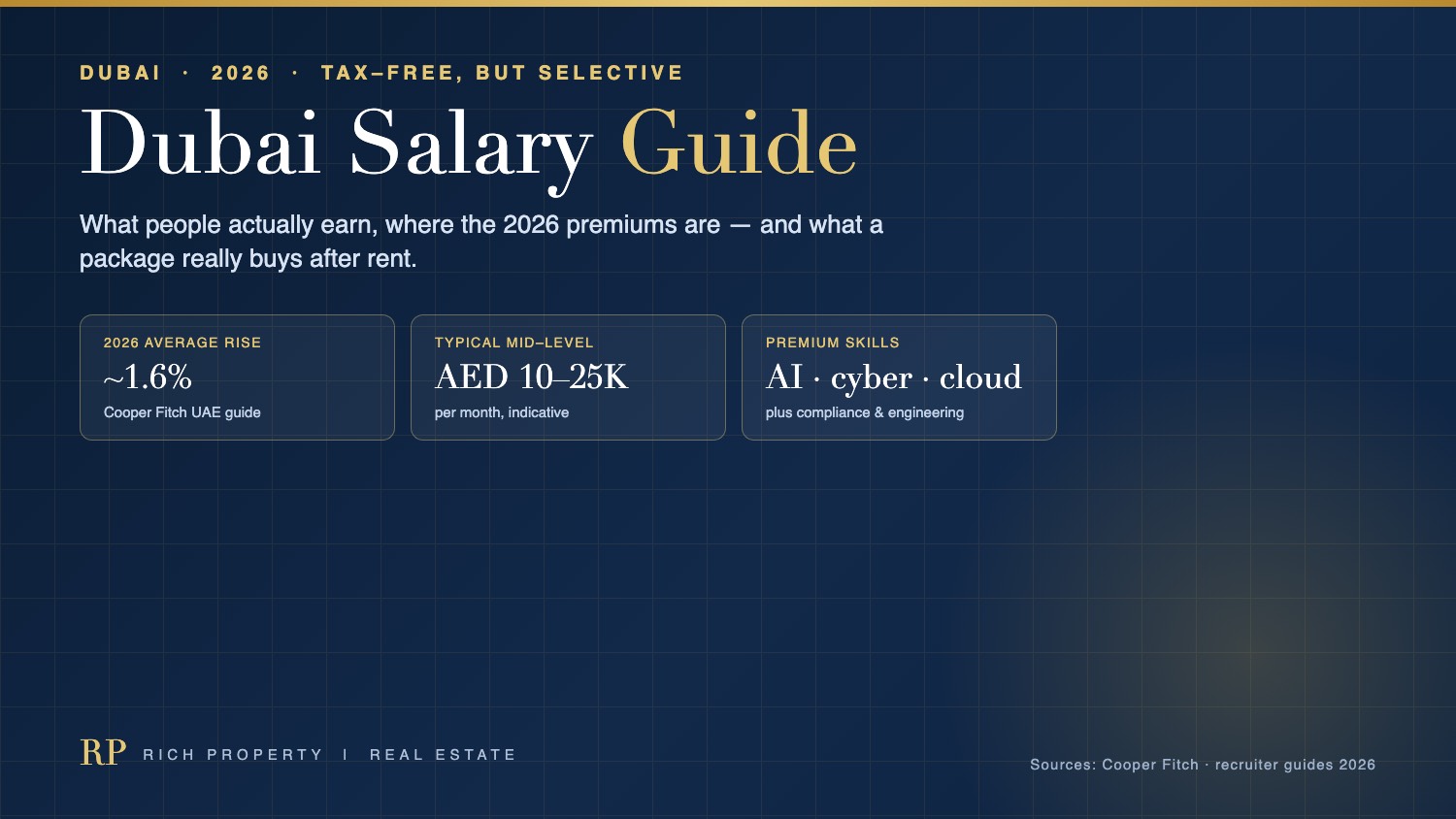
- Average pay rise expected in 2026: about 1.6% across the UAE, with most increases between 0 and 5% (Cooper Fitch, UAE Salary Guide 2026)
- 48% of companies plan to raise salary ranges this year; 37% expect flat ranges; 15% anticipate lower ranges for new hires
- Typical full–time bands reported by recruiter guides: entry roles roughly AED 4,000–8,000 a month, mid–level professionals roughly AED 10,000–25,000, with market averages commonly quoted around AED 15,000–20,000
- Bonuses: commonly 1–3 months’ salary; in financial services 10–40% of annual basic
- Hot skills commanding premiums: AI, data, cyber security, cloud, compliance, specialised engineering
The 2026 Reality: Selective Raises
The days of across–the–board double–digit increases are over for now. Cooper Fitch’s UAE Salary Guide 2026 puts the average expected rise at 1.6%, with the workforce expanding fast enough to moderate pay growth. Almost half of employers still plan to lift salary ranges — but the increases concentrate on roles that are genuinely hard to fill.
What earns a premium in 2026: AI and data skills, cyber security, cloud architecture, compliance, specialised engineering, and leadership roles tied to business transformation. Generic support roles are seeing little movement. Technology, financial services, healthcare and energy are the strongest sectors.
What People Actually Earn
Exact figures vary by company, nationality of contract, and negotiation — treat all of the following as indicative bands drawn from the major recruiter guides, not promises:
- Entry level and junior roles: roughly AED 4,000–8,000 per month
- Mid–level professionals: roughly AED 10,000–25,000 per month
- Market averages quoted across guides sit around AED 15,000–20,000 a month, with average annual packages of AED 270,000–290,000 across sectors
- Senior and specialist roles in finance, tech and executive positions go far higher — and bonuses of 1–3 months are common, rising to 10–40% of basic in financial services
The Question That Matters: Salary vs Cost of Living
Tax–free means your gross is your net — but Dubai takes its share through rent instead. The arithmetic that decides whether an offer works:
- A single professional living in a mid–market studio needs roughly AED 8,600 a month all–in
- A couple in a one–bedroom with a car needs roughly AED 14,600
- A family of four with one child in school needs roughly AED 26,300
Those are our own worked budgets — every line item is in our Dubai cost of living breakdown. Put simply: an AED 15,000 offer is comfortable for a single person, tight for a family; an AED 30,000 package changes which schools and which neighbourhoods are realistic.
Reading a Dubai Job Offer Properly
- Is housing included or an allowance? Rent is 40–55% of most budgets — this single line dominates the package
- Who covers dependants’ health insurance? Employers must cover employees; family cover is often on you
- School allowance: fees run from AED 15,000 to past AED 100,000 per child per year
- Gratuity: end–of–service pay is a legal entitlement under UAE labour law — understand how it accrues
- Probation and notice terms, and whether the bonus is contractual or discretionary
Where Your Salary Goes Furthest
Housing choice moves the needle more than any raise. Moving one district inland from the waterfront routinely saves 30–40% of rent for the same space — the difference between saving nothing and saving AED 5,000 a month on the same salary. Our guides to Business Bay prices and the legal limits on rent increases are the practical starting points.
And once a salary is stable, the rent–versus–buy question arrives fast: five years of AED 100,000 rent is half a million dirhams with nothing owned at the end. The honest comparison is in our step–by–step buying guide — including the mortgage caps that apply to expat salaries.
Moving to Dubai for work?
Rich Property is a RERA–registered brokerage in The Opus Tower, Business Bay. Tell us your package and we will tell you honestly which neighbourhoods fit it — rent or buy — including the service charges and fees most calculators leave out. No pressure, just the numbers.
Browse Dubai PropertiesFAQ - Dubai Salaries 2026
What is a good salary in Dubai in 2026?
For a single professional, packages from roughly AED 12,000–15,000 a month are comfortable; couples are comfortable from around AED 20,000; families with school fees generally need AED 30,000–35,000 to live well and save. It depends overwhelmingly on your housing choice.
Are Dubai salaries really tax-free?
Yes — there is no personal income tax on salaries in the UAE. VAT of 5% applies to most goods and services, and housing costs effectively replace the tax burden.
Will salaries rise in 2026?
Selectively. Cooper Fitch’s UAE Salary Guide 2026 expects an average rise of about 1.6%, with most increases between 0 and 5% and premiums concentrated on AI, data, cyber security, cloud, compliance and specialised engineering skills.
What is the average salary in Dubai?
Recruiter guides commonly quote market averages around AED 15,000–20,000 a month, with average annual packages of AED 270,000–290,000 across sectors. Averages hide huge variation by industry and seniority.
What bonus should I expect?
Commonly one to three months’ salary; in financial services, bonuses of 10–40% of annual basic are reported. Confirm in writing whether a bonus is contractual or discretionary.
How much of my salary will rent take?
Typically 40–55% of a Dubai budget. A studio in a mid–market area runs about AED 60,000 a year, a family two–bedroom in a prime district can exceed AED 150,000 — area choice matters more than most raises.
Sources
Sources: Cooper Fitch UAE Salary Guide 2026 (average 1.6% expected rise, distribution of planned increases, in–demand skills), as reported by The National, January 2026; salary bands compiled from published 2026 recruiter guides including Cooper Fitch, Hays and Michael Page coverage. All salary figures are indicative market ranges, not guarantees, and vary by employer, sector and negotiation. Cost–of–living figures are Rich Property’s own worked budgets published in our Dubai cost of living guide, based on DEWA, Salik, RTA, DLD and KHDA published rates. This article is general information, not career or financial advice.